

A sickness absence review meeting for employers provides a structured way to discuss an employee’s attendance, health and ability to work.
The meeting may follow repeated short absences, a prolonged period away from work or an absence trigger under the employer’s policy.
Employers should approach the discussion fairly and with an open mind. The purpose is to understand the circumstances, identify support and decide what action may be appropriate.
What is a sickness absence review meeting?
A sickness absence review meeting is a formal or informal discussion between an employer and an employee about their attendance record.
It differs from a routine return-to-work conversation because it usually considers a broader pattern or continuing concern. The employer may review previous absences, medical information and the effect on the organisation.
The meeting should not automatically result in a warning. Instead, it should help the employer establish whether the absence involves an underlying condition, workplace problem or other issue requiring action.
The employer should follow its sickness absence policy and apply the procedure consistently. However, disability, pregnancy and other protected circumstances may require a different approach.
When should employers arrange a review meeting?
A sickness absence review meeting for employers may become appropriate when an employee reaches an attendance trigger or when absence begins to affect the business significantly.
Possible reasons include:
- several separate periods of short-term sickness;
- a developing pattern of absence;
- long-term sickness with no clear return date;
- concerns about whether the employee can perform their role;
- the need to discuss medical evidence or adjustments; or
- a previous support arrangement that has not improved attendance.
Trigger points should prompt a review rather than an automatic penalty. Employers should examine the reason for each absence before deciding what follows.
Our employee sickness management page explains the wider process for recording and managing absence.
Inviting the employee to the meeting
The employer should give the employee reasonable notice and explain the purpose of the meeting.
The invitation should identify the attendance concerns and provide relevant records. It should also state whether the meeting could lead to a formal warning or another employment decision.
Where the employer’s policy permits accompaniment, the letter should explain who the employee may bring. Even where no statutory right applies, allowing a companion may help in sensitive or complex cases.
If the employee is too unwell to attend at the workplace, the employer should consider alternatives. These may include a video meeting, telephone discussion, written representations or postponement for a reasonable period.
Preparing for the sickness absence review meeting
Before the meeting, the manager should check that the absence record is accurate. They should distinguish between separate absences and identify any relevant patterns.
The manager should also review fit notes, occupational health advice, previous meeting notes and adjustments already considered.
Preparation should include assessing the effect of absence on staffing, workload, customers and costs. However, the employer should use factual evidence rather than general statements about inconvenience.
The manager should not decide the outcome before hearing from the employee.
Questions at a sickness absence review meeting for employers
A sickness absence review meeting for employers should allow the employee to explain their situation fully.
Useful questions may include:
- Is there an underlying reason for the absences?
- Does the employee expect further absence?
- Is work contributing to the health problem?
- Would medical or occupational health advice help?
- Could temporary or permanent adjustments improve attendance?
- Is there any other support the employer should consider?
The manager should avoid demanding unnecessary medical details. The discussion should focus on the effect on work, likely attendance and possible support.
Where repeated short absences are causing concern, our article on absenteeism at work explains how employers can respond consistently.
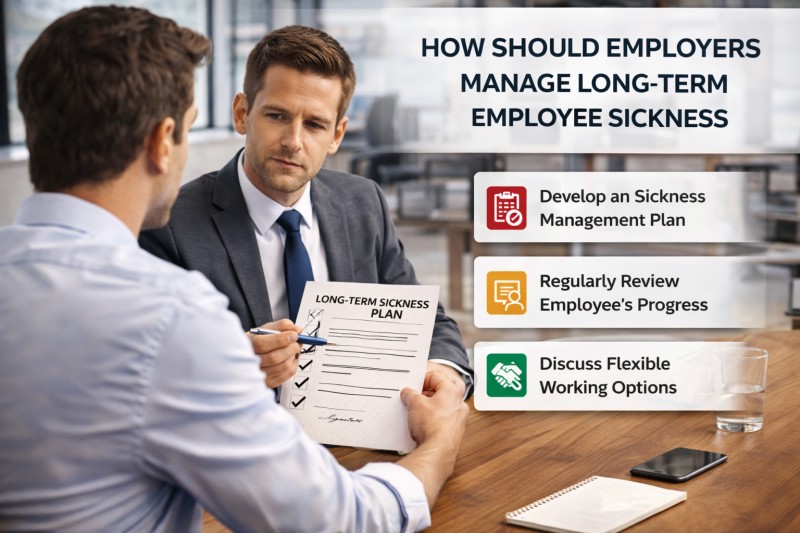
Considering disability and reasonable adjustments
An absence review may reveal that the employee has a physical or mental health condition that could amount to a disability under the Equality Act 2010.
If so, the employer must consider reasonable adjustments. These might include changing duties, working hours, absence triggers or workplace arrangements.
For example, it may be reasonable to discount some disability-related absence or increase the attendance level that triggers a formal review.
The employer should discuss possible adjustments with the employee and consider appropriate medical advice. Applying the policy identically to everyone can create discrimination risks where a disabled employee faces a particular disadvantage.
Pregnancy and family-related absence
Employers should record pregnancy-related sickness separately from ordinary sickness absence. They should not use it as a reason for disciplinary action or an attendance warning.
Absence connected with maternity leave and other protected family rights may also require separate treatment.
Managers should therefore check the reasons behind each absence before applying review points or deciding that attendance has become unacceptable.
Possible outcomes of the review meeting
The appropriate outcome will depend on the employee’s circumstances, attendance history and available evidence.
Possible outcomes include:
- no further action;
- informal monitoring for an agreed period;
- obtaining occupational health or medical advice;
- introducing reasonable adjustments or other support;
- setting an attendance improvement period;
- issuing a formal warning under the absence policy; or
- arranging a further review meeting.
The employer should explain the outcome and confirm it in writing. Where attendance expectations apply, the employee should understand what improvement is required and what may happen if it is not achieved.
When can dismissal become a possibility?
Continued sickness absence can eventually lead an employer to consider capability dismissal. However, dismissal should normally remain a last resort.
Before reaching that stage, the employer should obtain suitable medical evidence, consult the employee and consider reasonable adjustments and alternative work.
It should also examine the likely duration of the absence, the effect on the organisation and whether further support could enable a reliable return.
Our article on dismissal for repeated absence considers the steps employers should take before ending employment.
Recording and reviewing the outcome
The employer should keep an accurate record of the discussion, evidence considered and decisions reached.
The written outcome should include any agreed adjustments, attendance expectations and review date. The employee should have an opportunity to correct factual inaccuracies.
Employers should store health information securely and restrict access to managers who need it for legitimate workplace decisions.
Common absence review mistakes
Employers often create risk by treating trigger points as automatic disciplinary offences or deciding the outcome before meeting the employee.
Other mistakes include ignoring disability-related absence, relying on outdated medical evidence and failing to explain what improvement is required.
A fair review should consider both the organisation’s operational needs and the employee’s individual circumstances.
Advice on sickness absence review meetings
A sickness absence review meeting for employers should identify the cause and impact of absence before formal action begins.
Employers Law helps businesses prepare review meetings, consider adjustments and manage persistent or long-term absence fairly.