
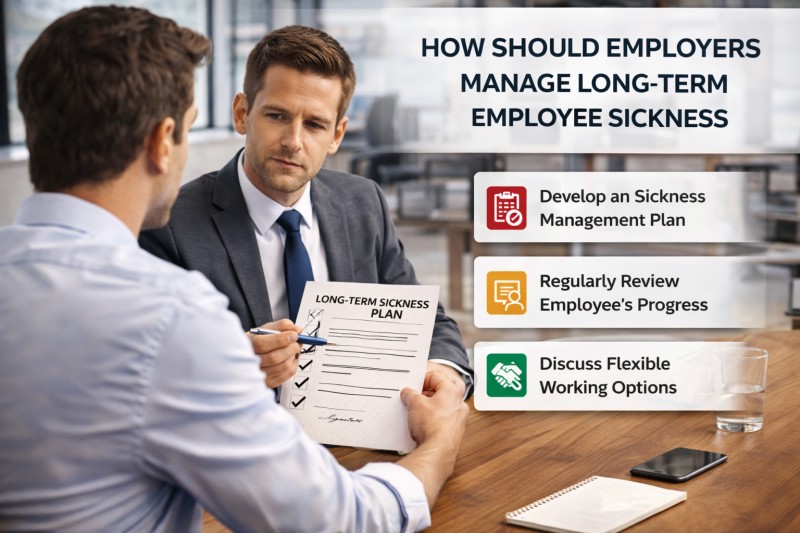
How should employers manage long-term employee sickness is a question I am asked by business owners who are trying to balance compassion with legal obligations. Long-term absence can be challenging, both operationally and legally, and getting it wrong can expose employers to significant risk.
If you need expert help, see our Employee Sickness Management
The key is to follow a fair, structured, and well-documented approach. Employers should consider both the employee’s wellbeing and the needs of the business, while ensuring compliance with UK employment law.
How should employers manage long-term employee sickness from the outset?
When an employee’s absence becomes long-term, employers should act early. This may suggest putting clear processes in place from the start, rather than waiting until the absence becomes problematic.
Employers should consider:
- Maintaining regular and appropriate contact with the employee
- Keeping accurate records of all communications and decisions
- Ensuring policies employee sickness clauses in their Contracts of Employment are followed
In my experience, early engagement helps prevent misunderstandings and shows the employee that the employer is taking the situation seriously.
Managing long-term employee sickness with medical evidence
Medical evidence plays a central role when considering how should employers manage long-term employee sickness. Employers should not rely on assumptions about an employee’s condition or capability.
This may suggest obtaining up-to-date medical information, which could include:
- Fit notes from the employee’s GP
- Occupational health reports
- Consent-based medical questionnaires
Employers should consider whether the employee is likely to return to work, and if so, when. However, medical opinions are not always definitive, so decisions should be made carefully.
Where appropriate, referring the employee to occupational health can provide valuable insight into adjustments or phased returns.
Making reasonable adjustments
Another key aspect of how should employers manage long-term employee sickness is considering reasonable adjustments, particularly where the illness may amount to a disability under the Equality Act 2010.
In my experience, employers should consider whether adjustments could support a return to work. These may include:
- Reduced hours or flexible working arrangements
- Temporary or permanent changes to duties
- Additional support or equipment
This may suggest that dismissal should not be considered until all reasonable adjustments have been explored. Failing to do so could lead to discrimination claims.
Employers should also document what adjustments were considered and why certain options were or were not feasible.

Managing long-term employee sickness during absence reviews
Regular review meetings are essential when considering how should employers manage long-term employee sickness. These meetings help employers stay informed and demonstrate a fair process.
In my experience, review meetings should be:
- Scheduled at reasonable intervals
- Conducted sensitively and professionally
- Documented with clear outcomes
Employers should consider discussing:
- The employee’s current health and prognosis
- Any support required
- Possible return-to-work plans
These discussions should not feel like disciplinary meetings. Instead, they should focus on support and understanding, while still addressing business needs.
Managing long-term employee sickness when considering dismissal
At some point, employers may need to consider dismissal. However, how should employers manage long-term employee sickness at this stage requires particular care.
Dismissal may be fair in certain circumstances, such as where there is no clear prospect of return and the absence is having a significant impact on the business. That said, employers should follow a fair capability process.
This may suggest:
- Holding a formal capability meeting
- Allowing the employee to be accompanied
- Considering all medical evidence before making a decision
In my experience, employers should also ensure that alternatives to dismissal have been fully explored. This includes adjustments, redeployment, or extended absence where reasonable.
Importantly, any decision to dismiss should be reasonable in the circumstances and supported by evidence.
How should employers manage long-term employee sickness to reduce legal risk?
Managing long-term sickness incorrectly can lead to claims such as unfair dismissal or disability discrimination. Therefore, how should employers manage long-term employee sickness in a legally compliant way is critical.
Employers should consider:
- Following a clear and consistent sickness absence policy
- Applying procedures fairly across all employees
- Keeping detailed written records at every stage
In addition, employers should ensure that policies align with their Employee Sickness approach and wider HR practices.
This may suggest that seeking professional advice at an early stage can help avoid costly mistakes later on.
Managing long-term employee sickness alongside business needs
While supporting employees is important, employers must also consider operational requirements. How should employers manage long-term employee sickness often involves balancing these competing factors.
In my experience, employers should consider:
- The impact of the absence on workload and colleagues
- The cost of temporary cover or redistribution of duties
- The long-term sustainability of keeping the role open
This may suggest that there comes a point where continuing the employment relationship is no longer viable. However, decisions should always be made carefully and with supporting evidence.
Employers should avoid rushing decisions, particularly where the employee may still have a reasonable prospect of returning.
Conclusion
How should employers manage long-term employee sickness is not a simple question, and each situation will depend on its own facts. However, a fair, consistent, and well-documented approach will help employers manage both legal risks and employee relations effectively.
In my experience, the most successful outcomes arise when employers communicate clearly, obtain appropriate medical evidence, and explore all reasonable options before making decisions.
Employers should consider seeking advice where there is uncertainty, particularly in complex or high-risk situations. Taking the right steps early can prevent disputes and protect your business.